
Course Name: Preparing for the Canadian Amateur Radio Examinations (page updated 2026-05-10)
How to join a course
Enter your name and any questions you may have using our Contact Form to be placed on our list. The course fee of 100 CAD will be called for in late August. We have room for a maximum of 32 students with a usual attendance of 20 – 25. We have 17 requests to date.
2026 Dates and topics
Our 2026 September start course will be held in Colwood at Emery Hall.
If you are already familiar with electronics, you are welcome to join late and sit the exam with us.
Dates for our 9 week course are Friday evenings:
- 2026-09-11T18:00-21:00 Introduction
- 2026-09-18T18:00-21:00 Ohm’s Law, Inductors and Capacitors
- 2026-09-25T18:00-21:00 Waves and propagation
- 2026-10-02T18:00-21:00 Transmission Lines and Antennas
- 2026-10-09T18:00-21:00 Solid state electronics, Power Supplies and Establishing an Amateur Station
- 2026-10-16T18:00-21:00 Modulators, Transmitters and Receivers
- 2026-10-23T18:00-21:00 Safety and Regulations (25% of exam!)
- 2026-10-30T18:00-21:00 Exams: Basic and optional Advanced.
- 2026-11-06T18:00-20:00 Optional field trip to Keating Cross Road Provincial Emergency Radio Room
We have 5 different instructors with extensive experience and our club president usually comes for at least the first and last classes.
Examiners
WARA has two examiners available for the September course.
“Taking an amateur course is a good idea but not mandatory.” We do perform examinations for self studied students. You do not have to be a WARA member to take an exam with us. We will be using Radio Amateurs of Canada’s Hamstudy Basic 2026: https://www.amazon.ca/Hamstudy-Basic-2026-Everything-Qualification/dp/B0GD6J4GMN/ref=sr_1_3?sr=8-3. When you believe you are ready for an exam, send an email using the above Contact Form and one of our examiners will make arrangements with you.
You could also participate in our upcoming Public Service activities to gain some practice by pairing up with some of our experienced operators before your examination:
- Times Colonist 10K run: Weekend of 2026-04-26
In person course details
Take Victoria’s amateur radio course, sponsored by the Westcoast Amateur Radio Association, and become a qualified amateur radio operator. This course will guide you through the process of learning the material required to pass the Canadian Amateur Radio Certificate Exam Basic Level. You will have access to a variety of different forms of radio communications including, voice, digital voice, Morse code, packet and many more on VHF and UHF bands.
In addition, a passing grade of 80% or more will also get you the designation of Basic with Honors, giving you the privileges of operating a ham radio station on the long distance HF frequencies (30 MHz and below).
Some of the more exotic things a ham operator can do include:
- Entering the great many radio communication contests available with points and certificates for high scores. Examples are Parks On The Air (POTA) and Summits On The Air (SOTA).
- Talking to the International Space Station
- Using internet-via-radio to talk to Antarctica, Australia, Asia, or Europe
- Practicing Moon bounce and satellite communication
- Exploring solar flux
- Contacting Japan / Australia / Brazil / Western Europe / all of the US and Canada using just 5 watts with the FT8 digital modulation
- Or, just talking to friends in Victoria, Canada, and the whole wide world!
Most of the local municipalities and cities within the Victoria area have emergency amateur radio communication groups. This is a great place to make connections with fellow ham operators, learn new skills related to the hobby and to provide a valuable service to the community in the event of significant emergency in the area.
Over an 8 class period we will have classroom sessions once per week where we will have experienced radio operators guide you through the learning sessions mostly by using slides shown on a television screen at the front of the class. Several of the instructors will bring in their own radio equipment for show and tell. There will be hands on opportunities to operate and learn with ham radio equipment. There will always be time for questions during each class. We encourage students to take advantage of the experience of the instructors. If you don’t know something, your fellow students will also likely benefit from the discussion. If they don’t know the answer to your questions, they will certainly be able to help find it.
Important! Studying and preparing for your basic amateur radio exam requires substantial effort and extensive reading. The questions aren’t too hard to understand, but there are 984 of them. The official question bank (with answers) is available at https://ised-isde.canada.ca/site/amateur-radio-operator-certificate-services/en/amateur-radio-exam-generator. There is also a set of reference formulas and diagrams. You are permitted to use the unlabeled versions during the exam (we will provide printed copies for everyone) Reference Material for Amateur Radio Exam – Basic Qualification. If you aren’t sure if you can commit the time required, have a look at a few random exam questions and try to research the answers using your favorite internet search engine. If you find yourself low on time as the exam approaches, concentrate on the question bank and understanding the differences between the two close answers out of the 4 available multiple choice options.
Our classroom sessions will include review of the readings from the study guide and on the requirements and regulations surrounding the operation and use of amateur radio stations. We hope to provide a comfortable and friendly learning environment. We encourage participants to get to know each other as this will give you a small group of friends who will be going on the air at the same time as you. Consequently, you need never wonder who you can call to test out your brand new radio – simply call one of your classmates or instructors! The connections you will make during the course can follow you for many years as this is a hobby that promotes interactions with fellow operators.
During the course, we will also be arranging optional opportunities to visit ham radio operators in their home “shacks” as well as ride-alongs to experience operating in a mobile environment. Each student should get an opportunity to listen and talk on some various types of equipment and frequency bands. As long as you are under the supervision of a qualified operator, you are encouraged to speak on the air before your receive your call sign.
The examinations come around all too soon. Writing the multiple choice Basic exam usually takes about 45 minutes and you will know your results within minutes. The examiner uses a light box with an answer key to mark it very quickly. Once you pass your exam and get a call sign you are good to go on the air solo and start enjoying this exciting new hobby. Although we will not be covering much of the Advanced Certificate material in our course there will be an opportunity for those who are interested, and prepared, to write the Advanced exam or the Morse code exam. Additional requirements to study for the Advanced level (purchase the advanced study guide) and Morse code exam (borrow or buy an iambic double paddle key) can be discussed with the instructors.
Location
Emery Hall is located in Colwood at 537 Glencairn Lane V9B 2B3 with gps coordinates of 48.43840674044145, -123.48929077228055. Note that Glencain Lane does not connect directly to Sooke Road: you have to turn north west onto Mt View Ave next to the Shell station.
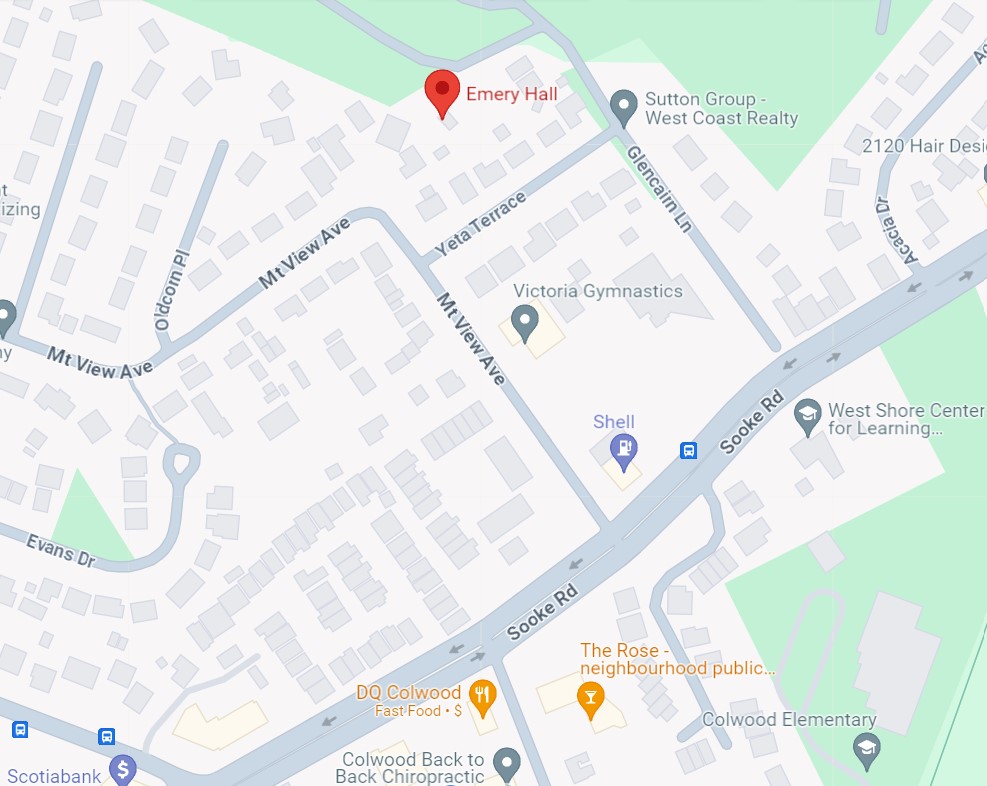
Map to Emery Hall in Colwood
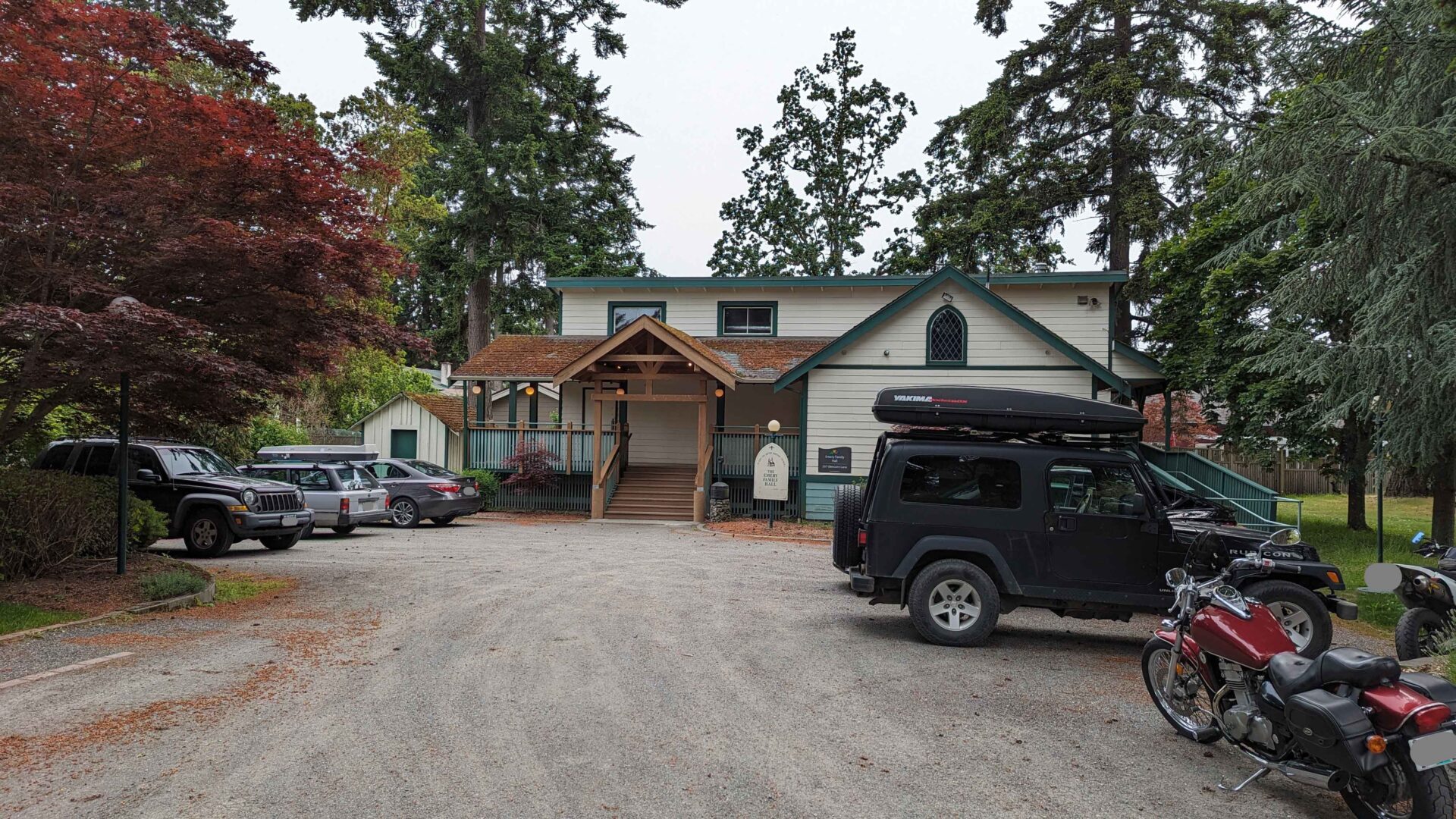
Parking lot outside of Emery Hall in Colwood. There is more parking behind the view from the camera on the gravel part of the road alongside the adjacent Saint John the Baptist Church.
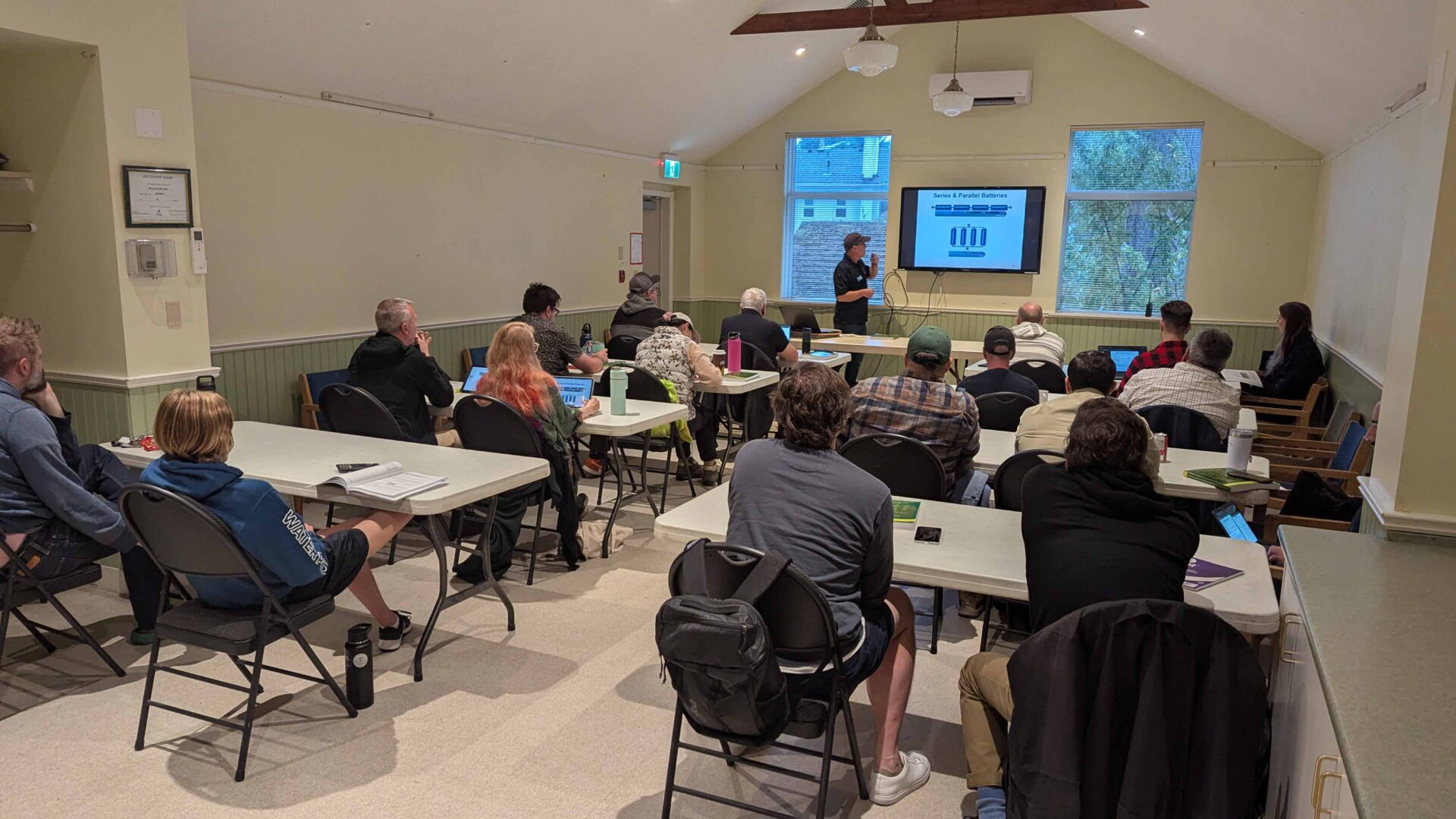
2025 Fall class with tables and chairs set up for 16 students.
Maximum class size is 32 students. Extra chairs will be placed at the ends of each table which will be further staggered. The kitchen is behind the camera. Three separate washrooms are through the door (not shown) to the left. There is a wheelchair ramp available to enter the back of the building.
The text on the television screen between the windows was scaled up to enable legible viewing from the back of the room. Some students bring laptops or tablets and follow along with the slide decks from their seats. The slide decks are in .odp format which can be opened by the free application that can be downloaded from https://www.libreoffice.org/ . Power Point format can be made available, but the animations may not work correctly. The password to download these slide decks from https://www.ve7vic.ca/wara-ham-class-documentation/ will be supplied once your tuition is received. There is local Wi-Fi available in the classroom (the password is written above the light switch).
Tuition:
- Adults: 100 CAD per person.
- 16 years old and younger with an attending tuition paid parent: free. Two 12 year old students recently achieved honors exam scores.
- Exam only: 20 CAD.
Tuition Includes:
- 8 evening classroom sessions
- Visits to home and mobile stations with local hams
- Coffee, tea, hot chocolate and chocolate chip cookies for the mid evening breaks
- Examination fees for Basic and optional Advanced or Morse code examinations taken on exam day
- Membership in WARA (valid up to renewal time in 2027 December).
What happens to the tuition fees?
- Payment to the city of Colwood for the rental of Emery Hall.
- Most of the extra fees go directly to support WARA’s extensive repeater network. You are encouraged to use the system often as you become a fractional owner of it. The main repeater on Mount McDonald had a new large battery bank installed in 2022 at a cost of 10 000 CAD. If you support one repeater somewhere, you are very welcome to use all of them around the world.
- Much of the remainder of the tuition fees go towards radio equipment purchases in support of public service events such as Field Day and the CARHA hockey tournament.
- All of the instructors and leadership of WARA are volunteers: no one in the club is paid.
- If you are only doing an exam, the 20 CAD fee is used for printing supplies and papers.
Additional materials
Students should download the following documents from Government of Canada Web site for study.
- Reference Material for Amateur Radio Exam – Basic Qualification
- RBR-4 Standards for the Operation of Radio Stations in the Amateur Radio Service
- RIC-3 Information on the Amateur Radio Service
- RIC-22 General Operating Procedures